
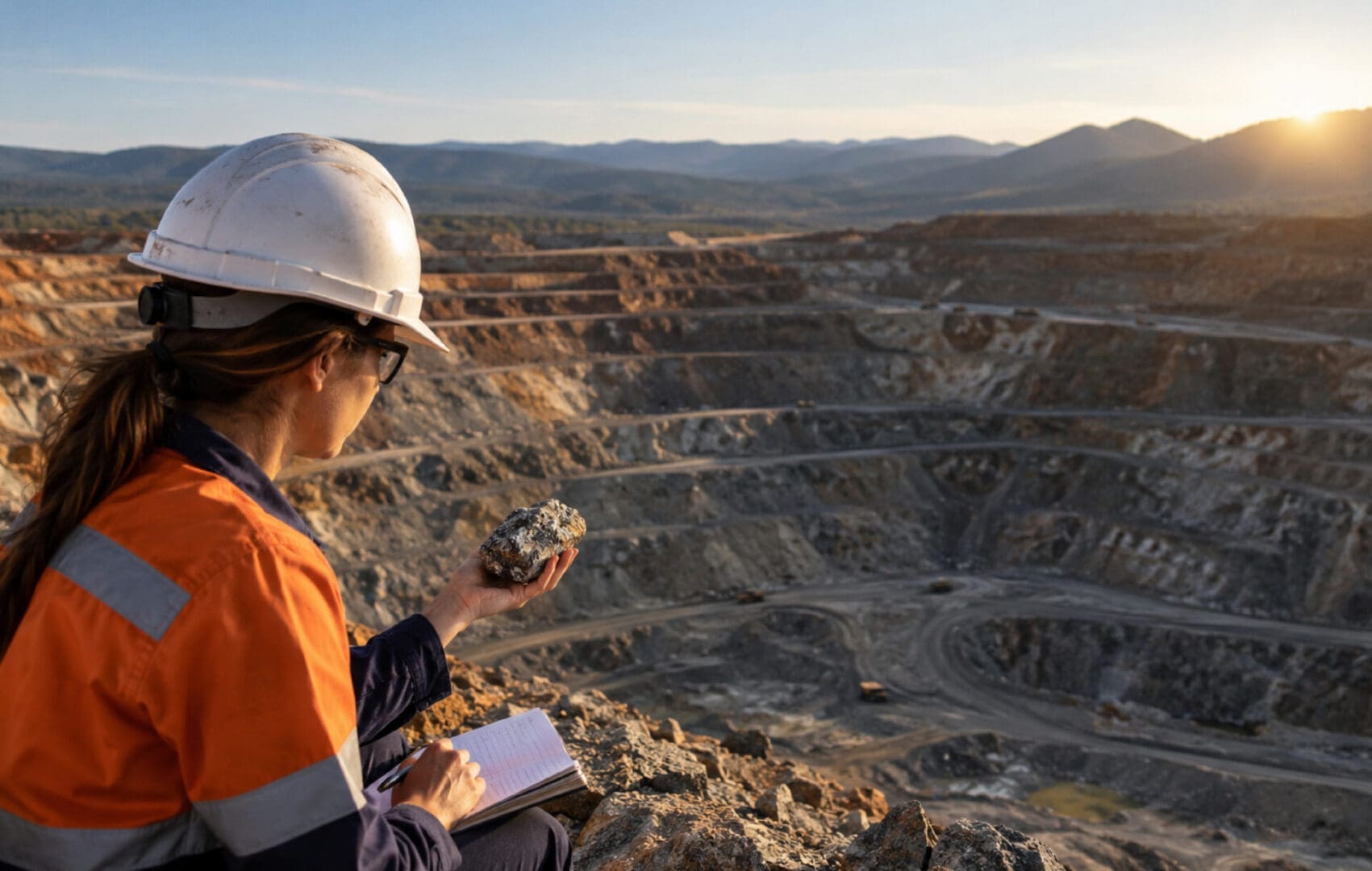
Mining projects are often compared by size, grade, commodity or economics. Yet two apparently similar orebodies can produce very different outcomes depending on how well their geological variability is understood. Grade and tonnage describe important characteristics of a deposit, but they do not tell the entire story.
An orebody is not a uniform volume of rock. It is the product of geological processes that create variations in lithology, alteration, mineralization, structure, geochemistry and mineralogy across space. Understanding those relationships is what allows a project to move from identifying mineralization to predicting how the orebody may behave.
A Resource Model Is Not the Orebody
A geological or resource model is a representation of the orebody based on the information available at a particular point in time. Drillholes provide observations, geological interpretation connects those observations and modeling extends that understanding into areas where direct information does not exist. The model is essential, but it should never be confused with the geological system itself.
As projects advance, increasingly consequential decisions depend on those interpretations. Resource boundaries, drilling priorities, mine plans and processing assumptions can all inherit the geological decisions made earlier in the project. The better the geological system is understood, the more confidently those assumptions can be tested and refined.
This is why understanding an orebody requires more than defining where mineralization begins and ends. It requires understanding the variability inside those boundaries.
Variability Is Information
Variability is sometimes treated primarily as something that complicates modeling. In reality, it contains information about how the mineral system formed and how different parts of the orebody relate to one another. Changes in lithology, alteration, geochemistry, mineralization and mineralogy can define meaningful geological populations that may not be apparent from grade alone.
Those populations can matter for different reasons as a project progresses. During exploration, they may help identify vectors, distinguish prospective from less prospective
parts of the system or improve targeting. During resource development, they may help constrain geological domains and continuity. Later, the same variability may become relevant to material characteristics, deleterious elements, processing behavior or geometallurgical domains.
The geological system does not change between exploration and mining. The questions being asked of it do.
Geochemistry Helps Explain the System
Geochemistry provides one of the most powerful ways to characterize variability within an orebody because every sample contains considerably more information than the commodity element alone. Multielement relationships can help distinguish lithologies, characterize alteration, identify mineralization signatures and recognize geological populations that may be difficult to separate visually. When evaluated spatially, those relationships provide another line of evidence for understanding how the system changes through the deposit.
This is particularly valuable where alteration has obscured primary lithological characteristics or where different geological units appear visually similar. Lithogeochemistry can help test geological classifications, while alteration and mineralization signatures can provide additional context for understanding boundaries and domains. Geochemistry can therefore move beyond describing where grade occurs toward helping explain why different parts of the orebody behave differently.
The objective is not to replace geological interpretation with geochemical classification. It is to integrate independent lines of evidence and determine where they support one another, where they do not and what those differences reveal about the geological system.
Understanding Changes as the Project Changes
The questions asked of an orebody should evolve throughout the project lifecycle. Early exploration may focus on whether a mineral system exists, where the strongest parts of that system are located and where drilling should go next. As drilling density increases, attention shifts toward continuity, geological boundaries and the internal variability of the deposit.
Resource development asks increasingly detailed questions about the geometry and continuity of geological populations. Mining and processing introduce another set of questions about how material characteristics vary spatially and whether those variations can affect operational performance. Data collected early in the project can become
valuable later if its geological context is preserved and the full dataset remains available for reinterpretation.
This continuity matters because knowledge is often lost at the transitions between exploration, resource development and mining. Each group may inherit the previous team’s models without inheriting the reasoning, uncertainty and observations behind them. Maintaining geological understanding across those transitions is just as important as maintaining the database itself.
More Data Does Not Automatically Mean More Understanding
Modern mining projects can generate enormous volumes of technical data. More drilling, more assays and increasingly sophisticated analytical techniques create opportunities to characterize deposits at levels that were previously impossible. But additional data only creates value when it helps answer a geological question.
A project can therefore be data rich and knowledge poor. Large datasets can still contain inconsistent classifications, poorly understood analytical populations or geological domains whose boundaries have never been independently tested. Increasing the volume or sophistication of the data does not resolve those problems unless the information is integrated into a coherent understanding of the geological system.
The objective should be to identify which uncertainties matter and determine what information is needed to resolve them. Sometimes that requires new drilling or analytical work. In other cases, the answer may already exist within datasets that have never been examined together.
Understanding Creates Optionality
Better orebody understanding does more than reduce technical uncertainty. It creates options.
A project that understands its internal geological variability can ask better questions about where to explore, how to define domains, where additional drilling will add the most information and which characteristics may matter later in development. When conditions change, whether through commodity prices, processing requirements, mine plans or new geological information, a well-understood system can also be reassessed more intelligently.
That flexibility has value because mining projects rarely develop exactly as originally envisioned. Geological understanding provides a foundation that can be revisited as the questions change rather than forcing each new decision to begin with another round of data collection.
The Most Valuable Orebody Is the One You Understand
Size and grade will always matter. So will metallurgy, infrastructure, jurisdiction, capital requirements and market conditions. But none of those considerations removes the need to understand the geological system that ultimately supports the project.
The most valuable orebody is not necessarily the one with the most data or the most sophisticated model. It is the one where teams understand what controls the mineralization, how the geology varies, which interpretations are well supported and where uncertainty remains. That understanding allows better questions to be asked throughout the project lifecycle and gives each new decision a stronger technical foundation.
