
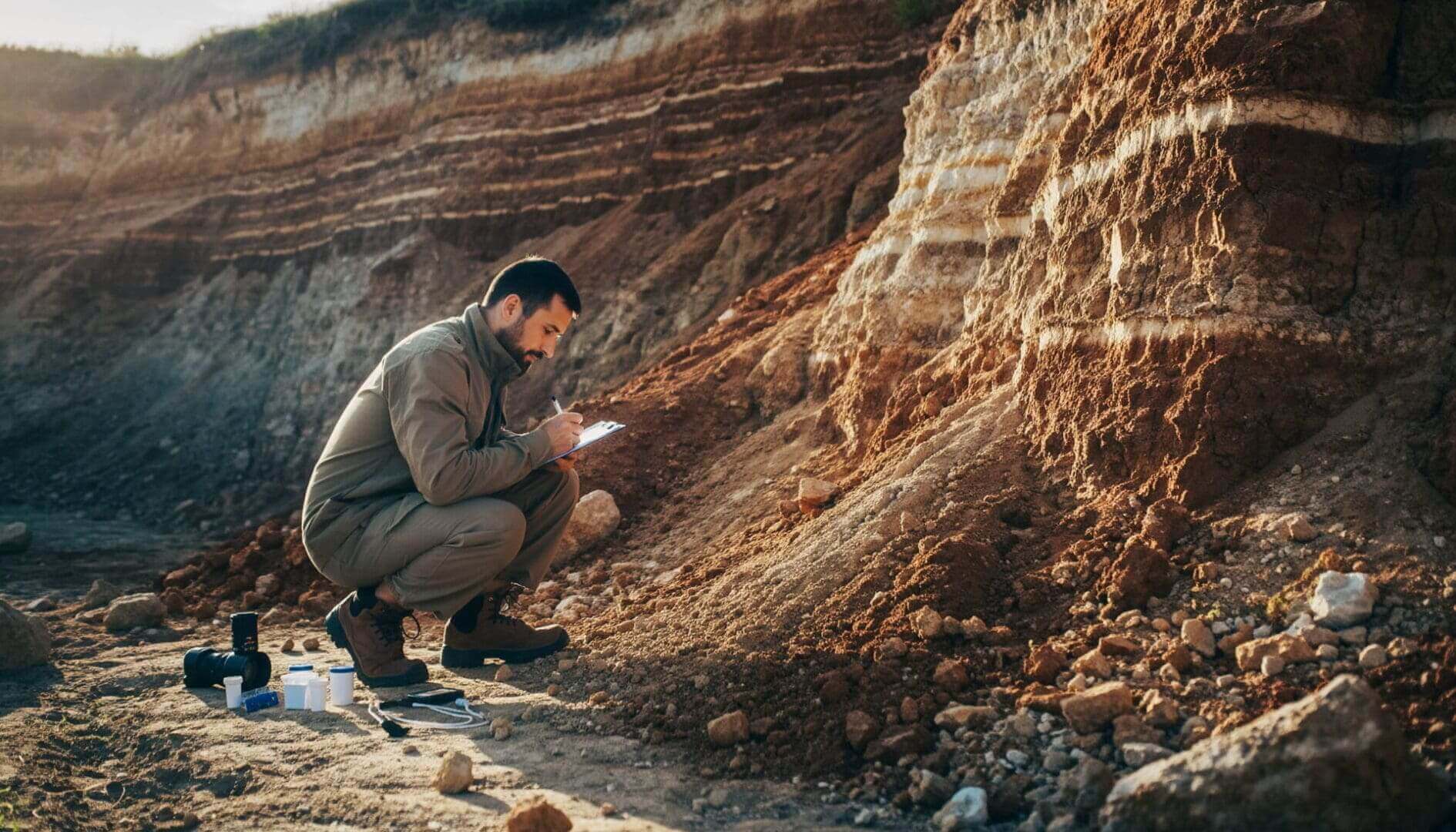
In geochemical exploration within regolith-dominated terrains, the difficulty lies less in detecting mineralization and more in understanding the processes that control surface geochemical signatures. Exploration in regolith is often framed as a limitation, something that obscures the signal and pushes programs toward deeper drilling, but the real issue is not the presence of cover, it is how we approach it. In most programs, we assume that samples collected across a grid are broadly comparable, when in reality they may represent entirely different materials formed through different processes. Alluvial gravels, colluvium, residual soils, and reworked surfaces can all occur within short distances of each other, each carrying a different geochemical story. If these materials are treated as equivalent, the dataset becomes internally inconsistent before interpretation even begins. The result is that variability introduced by sampling different materials is mistaken for geological signal, rather than recognized as an artefact of the regolith system itself.
A more effective approach starts with understanding the regolith itself. This means identifying whether material is transported or residual, determining its likely source, and recognizing how it has been modified since deposition. In transported terrains, the chemistry of a sample may reflect processes far removed from the underlying bedrock. Material can be diluted, enriched, or overprinted depending on transport pathways, hydrology, and surface processes. In some cases, the most meaningful signals are not carried by the bulk sediment at all, but by specific features formed through fluid movement or chemical concentration. If those features are not identified and targeted, they are effectively invisible within a standard sampling program.
This is where the concept of background becomes critical. Background is often treated as a statistical construct, but in regolith terrains it must be geological. Establishing a meaningful baseline requires sampling the same material under the same conditions, not simply collecting more data. Without this, anomalies can emerge from differences in regolith type rather than proximity to mineralization. Careful control on sampling medium and context allows element relationships to stabilize and makes interpretation more reliable. Without it, even advanced analytical methods will amplify noise rather than resolve signal.
Another common limitation is the way we conceptualize regolith in two dimensions. Most exploration workflows rely on maps and grids, which flatten what is inherently a three-dimensional system. Regolith profiles evolve vertically, shaped by weathering, fluid flow, and structural permeability. Signals measured at surface are often the product of processes operating at depth and moving upward over time. Ignoring this vertical component can lead to misinterpretation of both anomaly strength and position. Thinking in three dimensions, even at a conceptual level, allows for a better understanding of how geochemical signals are generated, transported, and preserved.
All of this leads to a broader question about how we prioritize exploration effort. There is a growing tendency to assume that the next generation of discoveries lies deeper, beneath increasingly complex cover. However, in many cases, the shallow environment has not been fully interrogated. Historical datasets were often limited by analytical methods, detection limits, and narrow element suites. When revisited with modern techniques and a better understanding of regolith processes, they can reveal patterns that were previously unrecognized. The issue is not that the signal is absent, but that it has not been properly extracted.
Exploring in regolith is therefore not about overcoming a barrier, but about working with a system. It requires attention to material, process, and context, and a willingness to move beyond purely two-dimensional thinking. When done well, it provides a direct pathway to understanding what lies beneath. And before committing to deeper and more expensive exploration strategies, it is worth asking whether the shallow system has truly been understood.
