
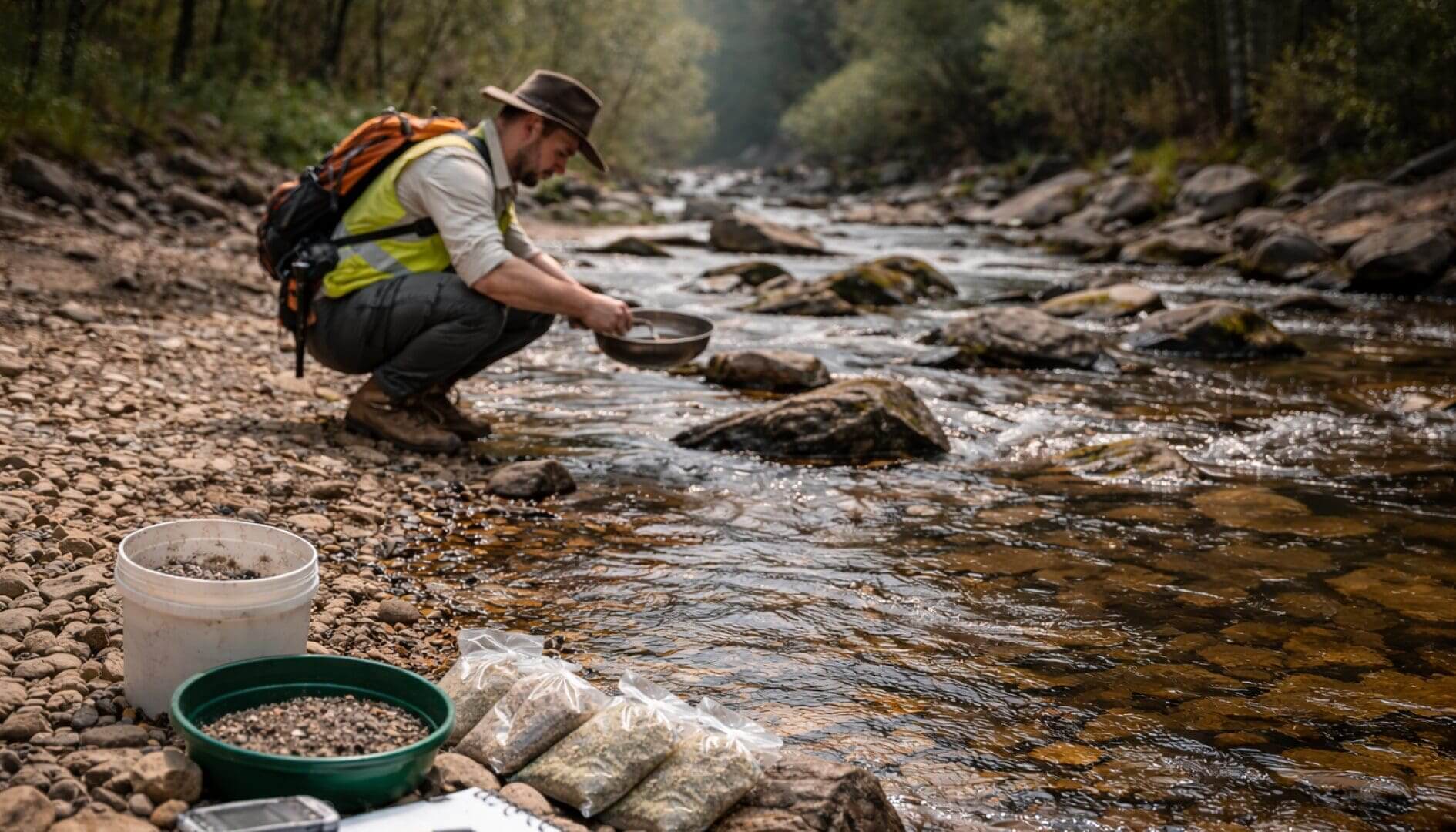
Stream sediment geochemistry is one of the most established tools in mineral exploration, providing a practical and powerful tool for targeting mineral deposits across wide terrains. The method involves the collection and analysis of sediments from streams and rivers to identify trace amounts of target and pathfinder elements. By understanding how these elements distribute themselves through natural processes in drainage systems, exploration teams can pinpoint areas with upstream mineralisation, which often remain hidden from traditional surface mapping. This approach has shaped exploration strategies across continents for decades, with scientific advances and innovations in sampling and data analysis progressively refining its application.
Principles of Stream Sediment Geochemistry
At its core, stream sediment geochemistry reflects the cumulative effects of erosion, chemical weathering, and sediment transport within a catchment. As rocks break down due to environmental forces, minerals and elements are released and carried downstream. The movement of these substances through rivers allows for their detection up to kilometres from their source. Exploration geochemists use this approach for regional scale targeting, particularly in terrains where vegetation, soil development, or recent cover obscure direct geological observations. Processing and interpreting the resulting geochemical signal, however, requires an understanding of the physical and chemical processes governing sediment transport, combined with rigorous statistical analysis.
Key Sediment Fractions: Bulk, Fine, and Clay
Choice of sediment fraction significantly influences the expression and interpretability of geochemical signals in exploration. Bulk, fine, and clay fractions each capture distinct aspects of elemental dispersion within a drainage system. Bulk sediment samples comprise a wide range of grain sizes, offering a representative mix of mineral sources. However, their diversity can dilute subtle geochemical signals because inert components like quartz commonly dominate the sample. Fine fraction samples, typically less than 180 µm or 75 µm, concentrate more chemically reactive surfaces where trace and pathfinder elements preferentially accumulate. Clay fraction samples, at less than 2 µm, exhibit the greatest surface area and electrochemical reactivity, making them highly sensitive to trace and pathfinder elements even at low concentrations.
Bulk Sediment Sampling
Bulk sampling provides a straightforward and rapid method for field programmes. Representative material is collected from stream beds to identify portions of a catchment that produce anomalous geochemical response. This approach performs well in high relief or coarse-grained environments, where larger particles reflect substantial mineral inputs from upstream sources. Its principal limitation is signal dilution, as high proportions of quartz or rock fragments can reduce sensitivity to subtle or deeply sourced anomalies.
Fine Fraction Sampling
Fine fraction sampling targets particles generally smaller than 180 µm or 75 µm. These particles have a higher surface area to volume ratio, enhancing adsorption of trace metals and metalloids. Fine fraction surveys often achieve better discrimination between background and anomalous populations, increasing the likelihood of detecting targets that bulk samples might miss. As a technique, it requires careful sieving procedures and attention to contamination and sample handling, factors that directly affect data quality and interpretability.
Clay Fraction Sampling
Clay fraction sampling targets particles smaller than 2 µm. These materials exhibit high surface area and electrochemical activity, which promotes strong adsorption of pathfinder and trace elements. The method is effective in terrains with intense chemical weathering, where metals commonly occur as adsorbed species or secondary phases. Clay sampling can highlight concealed or distal mineralisation, sometimes kilometres away from the source. This approach, while sensitive, demands rigorous laboratory procedures and skilled interpretation, as natural clays vary widely in composition and geochemical behaviour.
Controls on Geochemical Dispersion and Signal Quality
The quality and resolution of geochemical signals in stream sediments are governed by a combination of geological, environmental and physical processes operating within a catchment. Bedrock geology, catchment size, and the mineralogy of upstream rocks all impact what elements appear in downstream sediments. Weathering intensity, regional climate, and distance from the source further control element mobility, presence, and chemical speciation during dispersion.
Physical processes, such as hydraulic sorting, during transport can preferentially concentrate heavy minerals or dilute signals through the addition of lighter quartz-rich material. At the same time, chemical adsorption onto clays, oxides and organic matter creates additional layers of complexity, often amplifying or dampening the visibility of certain elements. These factors must be understood to interpret anomalies correctly and to avoid costly errors in exploration planning.
Role of Pathfinder Elements and Target Detection
One major advantage of stream sediment geochemistry lies in its ability to detect pathfinder elements, such as arsenic, antimony and mercury. These elements often disperse further downstream than the ore minerals themselves, extending the detectable geochemical footprint of mineralised systems. Fine and clay sediment fractions are particularly effective at capturing these pathfinder signals, allowing exploration geochemists to identify mineralization that is undetectable at the surface.
By evaluating the spatial distribution of pathfinder and trace elements ranging from copper, lead and zinc to the rare earths, stream sediment data can be used to prioritise catchments and focus follow-up exploration. When interpreted in context, insights can lead to more informed exploration decisions.
Best practises in Sampling and Analytical Methods
Sound sampling and sample preparation underpin all effective geochemical surveys. Consistent grain size separation ensures that samples from across a region are directly comparable. Field teams must use clean equipment, avoid cross contamination, and follow standardised procedures throughout collection and processing.
The choice of analytical method (whether partial or near-total digestion) should be guided by the target elements and their mineral hosts. Distinguishing elements that are geochemically mobile from those transported primarily as detrital grains, is critical for anomaly ranking and prioritizing follow-up work. To support reliable interpretation, field and laboratory workflows should be transparent, well-documented and regularly reviewed as methods and project objectives evolve. Together, these practices form the basis of tailored workflows designed to preserve data quality from the field to the laboratory analysis.
Importance of QA/QC in Stream Sediment Geochemistry
Quality assurance and quality control underpin the reliability of stream sediment datasets and must be embedded from field collection through to laboratory analysis. Field duplicates and analytical duplicates provide measures of precision, while certified reference materials, ideally matched to the local sediment matrix, provide a standard for evaluating analytical accuracy.
Stream sediment surveys are particularly sensitive to nugget effects, where metals occur in sparse but high-grade particles. These effects can introduce significant variability if not recognised and managed through appropriate sampling strategies and analytical checks. To ensure repeatability and data integrity, all aspects of sediment fraction selection, preparation, and analysis should be clearly documented and subject to routine review.
Data Interpretation and Integration
Stream sediment data represent spatially averaged signatures across upstream catchments rather than discrete point sources. As a result, anomalies reflect contributions from various sources rather than pinpointing individual mineral occurrences. Interpreting this data is strengthened by integrating geological maps, structural interpretations and geophysical datasets. Defining thresholds at the regional, rather than global, scale ensures that anomalies respond to true local anomalies rather than broader background variability, supporting more robust target ranking.
Choosing the Right Approach for Mineral Exploration Success
There is no universal best sediment fraction or sampling technique. Selection depends on project goals, mineral commodities, terrain, climate, and available resources. Fine and clay fractions may provide improved sensitivity when searching for deeply buried or subtle mineralisation, but bulk sediment sampling remains appropriate Specific geological and geomorphological settings.
Effective program design depends on understanding how physical sediment transport, chemical partitioning and analytical limitations influence geochemical signal expression. Workflows that incorporate rigorous QA/QC, robust EDA and clear knowledge transfer between field, laboratory, and interpretation stages support more reliable use of streadm sediment data in exploration decision making. When applied with scientific rigour and operational discipline, stream sediment geochemistry remains a dependable tool within the broader mineral exploration toolkit.
Applied Geochemistry Workshops and Training
Ongoing development in stream sediment geochemistry relies heavily on specialised training and applied workshops. Exploration geochemists and geoscientists must understand sediment fraction selection, field sampling techniques, analytical constraints, and the implications these choices have for downstream interpretation.
Applied workshops provide hands-on experience with current sampling protocols, QA/QC workflows, and exploratory data analysis approaches, allowing practitioners to work directly with real datasets and common challenges. Investment in technical training supports consistent program design, improves data interpretation, and enables practitioners to adapt to evolving analytical and computational methods. Maintaining this level of technical competence is essential for the effective application of stream sediment geochemistry across diverse geological settings.
