
Exploration teams have used satellite imagery for decades to understand regional geology, map alteration systems, and prioritize targets. Until recently, however, satellite remote sensing was limited in its ability to identify specific minerals at the surface.
A new generation of hyperspectral satellites is changing that. These systems measure reflected light in hundreds of narrow wavelength bands, enabling the detection of mineral-specific spectral signatures. For the first time, satellite imagery can move beyond highlighting “altered areas” to identifying minerals associated with hydrothermal systems.
How Satellites Detect Minerals
Satellite remote sensing measures sunlight reflected from the Earth’s surface across different wavelengths. Minerals interact with light in predictable ways, and these reflectance patterns can therefore be used to infer surface composition. In addition to reflected light in the visible and shortwave infrared (VNIR and SWIR, respectively) portions of the spectrum, sensors operating in the thermal infrared (TIR) measure the natural radiation emitted by the Earth’s surface. In this region, minerals are identified through differences in emissivity, which describes how efficiently a material emits thermal energy relative to an ideal blackbody. Variations in emissivity produce diagnostic spectral features that allow certain mineral groups, particularly silicates, to be distinguished.
The VNIR region is particularly sensitive to ferric iron minerals and iron oxides, while the SWIR region contains absorption features associated with hydroxyl-bearing minerals such as clays, micas, sulfates, and carbonates that commonly form during hydrothermal alteration. The TIR region responds to the vibrational properties of silicate minerals and can help identify silica-rich lithologies, feldspars, and quartz through their emissivity characteristics.
It is important to note that the historical limitations of satellite systems have not only been the number of spectral bands a sensor records (i.e., spectral resolution), but also where those bands are positioned in the electromagnetic spectrum. Many multispectral satellites concentrate most of their spectral bands in the VNIR region, with relatively few bands in the SWIR where many diagnostic hydrothermal mineral absorption features occur. As a result, even satellites with numerous bands may still struggle to distinguish between minerals that exhibit similar spectral behavior.
The Era of Multispectral Remote Sensing
For much of the past four decades, mineral exploration has relied on multispectral satellite imagery to map regional geology and alteration systems. Early satellite missions such as Landsat, followed by sensors like ASTER and more recently Sentinel-2, provided the first global datasets capable of detecting mineralogical variation at the Earth’s surface.
Multispectral sensors measure reflected light in a limited number of relatively broad wavelength bands distributed across the VNIR, SWIR and TIR regions of the electromagnetic spectrum. These datasets typically contain between ten and fifteen spectral bands, each covering a wide wavelength interval. Despite this limitation, multispectral imagery has proven extremely valuable for regional mineral exploration.
By combining specific spectral bands or calculating band ratios, geologists can identify surface features associated with hydrothermal alteration. Iron oxides such as hematite and goethite can be detected in the VNIR, while SWIR bands allow the identification of hydroxyl-bearing minerals including clays, micas, sulfates, and carbonates. These spectral responses enable multispectral imagery to highlight alteration footprints that may reflect underlying hydrothermal systems.
However, the ability of multispectral satellites to distinguish individual minerals is fundamentally limited. Each spectral band integrates reflectance over a relatively broad wavelength range, which means that subtle absorption features are often averaged or lost within the signal. Many alteration minerals share similar absorption features in the shortwave infrared, particularly those associated with Al–OH bonds near 2200 nm. As a result, minerals such as kaolinite, dickite, and pyrophyllite frequently produce nearly identical responses in multispectral datasets.
Band placement can also limit mineral discrimination. Many multispectral satellites concentrate most of their spectral coverage in the visible and near infrared regions, with fewer bands positioned in the SWIR where the most diagnostic absorption features for hydrothermal minerals occur. Even when SWIR bands are present, their relatively broad spectral width can make it difficult to resolve subtle differences in absorption position or shape.
For exploration geologists, this means that multispectral remote sensing is extremely effective at identifying areas of alteration, but rarely provides the mineralogical detail required to distinguish specific alteration assemblages or interpret fluid evolution within hydrothermal systems. In practice, multispectral imagery highlights prospective areas but cannot always resolve the mineralogical information required to refine exploration targets.
Hyperspectral Remote Sensing: A Step Change
Hyperspectral sensors measure reflected light in hundreds of narrow spectral bands, dramatically increasing the level of spectral detail available. Instead of sampling the electromagnetic spectrum at a handful of broad wavelength intervals, hyperspectral instruments collect data at fine spectral increments, allowing subtle mineral absorption features to be resolved.
Importantly, the ability to identify minerals from spectral data depends not only on the number of bands a sensor records, but also on where those bands are positioned within the electromagnetic spectrum and how narrowly they sample diagnostic absorption features. Some modern commercial satellites, such as WorldView-3, include numerous spectral bands and even extend into the shortwave infrared. However, these bands are still relatively broad and sparsely distributed compared with hyperspectral systems designed for detailed mineralogical analysis. As a result, while sensors like WorldView-3 can enhance lithologic mapping and alteration detection, they often lack the spectral precision required to resolve subtle differences between many hydrothermal minerals.
Hyperspectral sensors designed for mineral exploration overcome these limitations by densely sampling the electromagnetic spectrum with evenly-spaced narrow spectral bands. For example, the EnMAP satellite measures reflected energy across 246 spectral bands between 400 and 2450 nm, with spectral resolution on the order of 6–10 nm across the VNIR–SWIR range. This dense spectral sampling allows mineral absorption features to be characterized in far greater detail than is possible with multispectral sensors.
Many alteration minerals record information about fluid chemistry, temperature, and fluid–rock interaction. As a result hyperspectral mineral maps can reveal patterns related to hydrothermal processes. Spatial variations in minerals such as white mica, chlorite, or alunite may reflect temperature gradients, fluid pathways, or changes in host rock chemistry. When interpreted in geological context, these patterns can define alteration zonation, structural conduits, and mineralogical gradients that often act as vectors toward mineralization.
Importantly, hyperspectral data captures not only the presence of an absorption feature but also its precise position, shape, and depth. These characteristics are often diagnostic of specific minerals and variations in mineral chemistry, allowing hyperspectral sensors to distinguish minerals that appear nearly identical in multispectral imagery.
For exploration geologists, this capability opens the door to mapping minerals such as alunite, distinguishing kaolinite from dickite, identifying variations in white mica composition, and detecting minerals such as chlorite, carbonates, and buddingtonite that are often associated with hydrothermal systems.
In well-exposed systems, hyperspectral data can discriminate minerals that differ only slightly in spectral position. Kaolinite and dickite, for example, share similar absorption features near 2200 nm, but hyperspectral measurements can resolve the small wavelength shift between these minerals. This type of discrimination was previously possible only with airborne hyperspectral surveys or laboratory, handheld, and core-scanning spectroscopy.
Hyperspectral Satellites Are Now Operational
For many years hyperspectral satellite data remained largely confined to research programs and experimental missions. That situation has changed with the launch of new spaceborne hyperspectral sensors, most notably EnMAP and PRISMA.
These satellites provide continuous spectral coverage across the VNIR–SWIR range at spatial resolutions on the order of tens of meters, enabling mineralogical mapping across large regions of the Earth’s surface. While the spatial resolution is coarser than airborne hyperspectral surveys, the spectral quality is sufficient to identify mineral species where exposures are large enough and spectral signatures are well developed.
As a result, hyperspectral satellite data can now be used to map mineralogical patterns across entire exploration districts, providing a new source of information for early-stage targeting.
Limitations of Satellite Hyperspectral Data
Despite its potential, hyperspectral satellite data has important limitations that exploration teams must consider. The most significant constraint is spatial resolution. Most hyperspectral satellites operate with pixel sizes of roughly thirty meters, meaning that multiple surface materials may contribute to the measured spectral signal within a single pixel. This spectral mixing can complicate mineral identification in areas with heterogeneous surface cover.
Satellite measurements must also account for the effects of the atmosphere. As sunlight travels through the atmosphere it is partially absorbed and scattered by gases and aerosols before reaching the surface and again before returning to the sensor. Hyperspectral systems therefore rely on atmospheric correction to recover surface reflectance. In some wavelength regions, particularly near strong atmospheric absorption bands, signal quality may be reduced. These effects are the reason satellite instruments are designed to operate primarily within atmospheric transmission windows where reflected energy can be measured more reliably.
Surface exposure also plays a critical role. Vegetation, soil cover, and weathering can obscure diagnostic spectral features, reducing the ability of remote sensing systems to detect underlying mineralogy.
For these reasons, hyperspectral satellite mapping performs best in arid regions, in areas with good bedrock exposure, and in systems where alteration minerals occur in sufficiently large or continuous zones to be detected at satellite scale.
Integrating Hyperspectral Remote Sensing into Exploration
Hyperspectral satellite data is most powerful when integrated with other geological datasets. In exploration programs it can be used to screen large regions for hydrothermal alteration, map mineralogical zonation across prospects, and identify patterns that may reflect fluid pathways or structural controls.
When combined with lithogeochemistry, structural interpretation, and geophysical datasets, hyperspectral mineral mapping provides an additional layer of information that helps refine exploration models and prioritize targets.
Rather than replacing fieldwork, hyperspectral remote sensing helps guide it by highlighting areas where mineralogical patterns suggest the presence of hydrothermal systems.
A New Tool for Surface Mineral Mapping
Hyperspectral satellite data represents a significant advance in remote sensing for mineral exploration. Where traditional multispectral imagery could highlight alteration footprints, hyperspectral systems identify the minerals that define hydrothermal systems.
As additional hyperspectral satellites are launched and global datasets continue to expand, exploration teams will increasingly be able to integrate mineralogical information derived from space with geological and geochemical workflows on the ground. Used in this way, hyperspectral mineral mapping has the potential to transform satellite imagery from a regional reconnaissance tool into a powerful source of mineralogical insight for exploration.
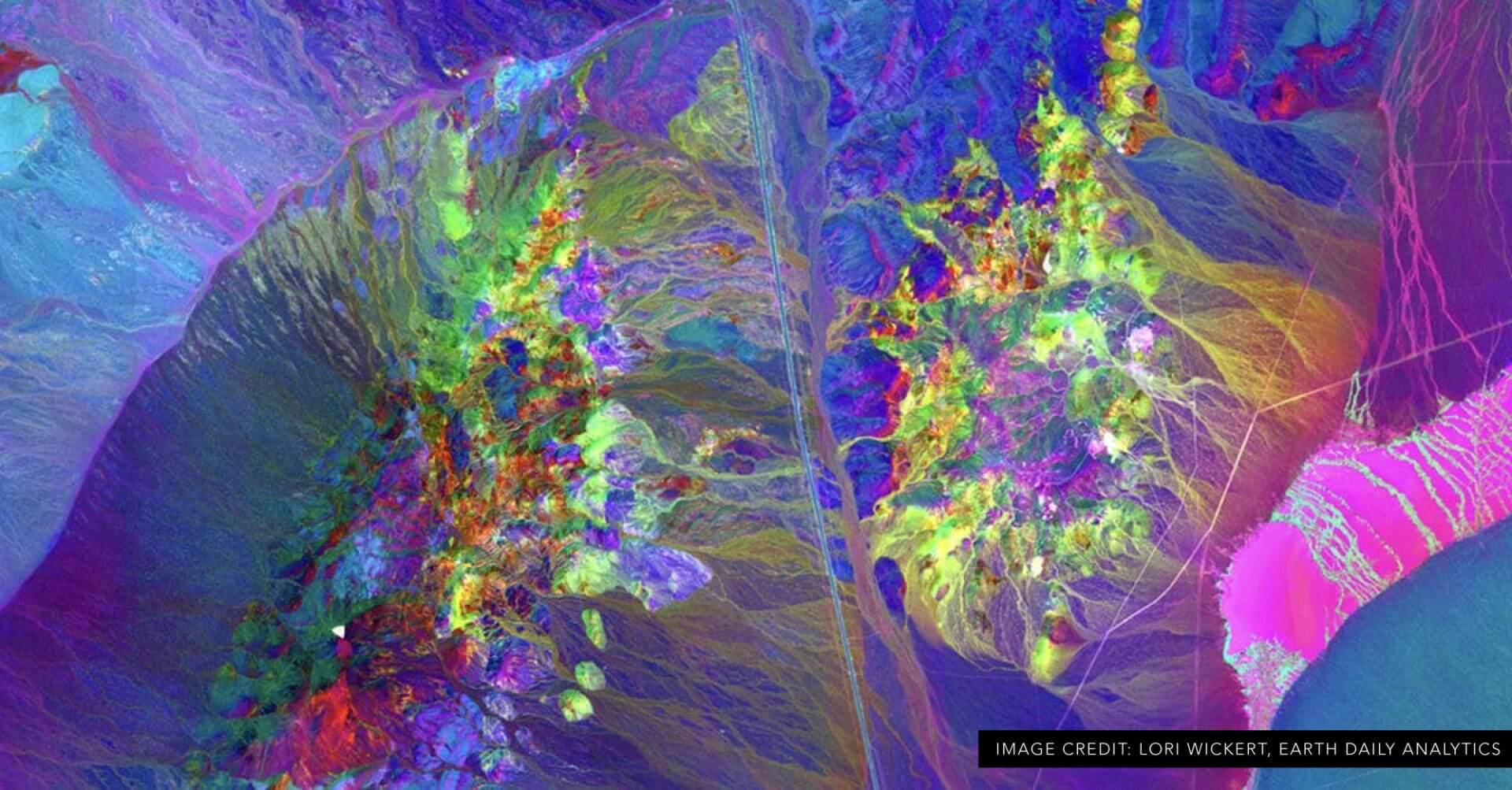
Image credit: EarthDaily Analytics. Hyperspectral PCA composite comparing EnMAP satellite data and SpecTIR airborne hyperspectral data, Cuprite District, Nevada. Source: EarthDaily blog.
Source Link: https://earthdaily.com/blog/hyperspectral-imaging-for-mining-enmap-satellite-data-versus-spectir-airborne-data
