
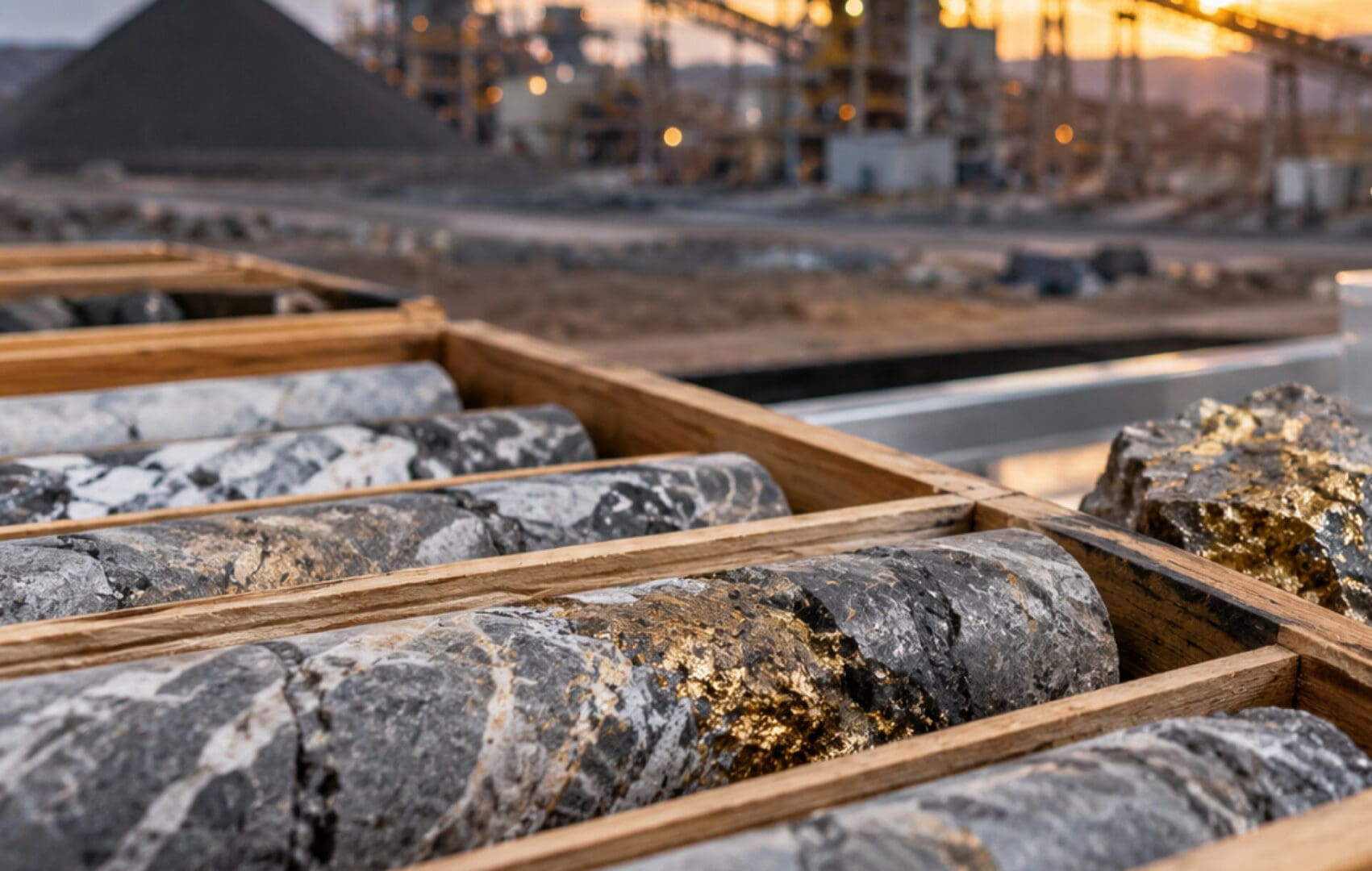
A drillhole returning 50 grams per tonne gold is extraordinary. The assay may be accurate, the laboratory work may be sound and the project may genuinely contain exceptionally high-grade material. But the assay answers one specific question: how much gold is present? It does not answer another question that ultimately matters to a mining project: how much of that gold can be recovered?
Grade and recovery are related, but they are not interchangeable. The relationship between metal contained in an orebody and metal ultimately recovered depends on how that metal occurs, the minerals associated with it, geological and mineralogical variability across the deposit and the processing approach applied to it. Understanding what happens between those two numbers is important for geoscientists, project teams and anyone evaluating the technical foundations of a mining project.
Grade Tells Us What Is There
An assay measures the concentration of an element within a sample. A gold assay of 50 grams per tonne tells us that the analyzed material contains that concentration of gold. It does not necessarily tell us which mineral hosts the gold, how it occurs, what it is associated with or how easily it can be separated from the surrounding material.
Two samples containing the same grade can therefore represent very different geological and processing propositions. Gold may occur in forms that are relatively accessible during processing or be associated with sulfides and other minerals in ways that make recovery more challenging. The grade can be completely accurate in both cases.
This distinction applies well beyond gold. Knowing how much copper, nickel or another commodity is present is only one part of understanding an orebody. How the commodity occurs within the rock provides another critical piece of the story.
Mineralogy Helps Explain What Happens Next
Mineralogy provides context that elemental concentrations alone cannot. Identifying which minerals are present, their abundance, how they occur and how they vary across an orebody can help explain why material with apparently similar grades may behave differently. This is also why no single mineralogical technology answers every question.
Hyperspectral methods are particularly useful for minerals with diagnostic spectral responses, including many clays, white micas, chlorites, carbonates and other alteration minerals. They can provide systematic mineralogical information along drill core and identify changes in mineral assemblages and composition across a deposit. This can be particularly valuable where alteration minerals or clays vary spatially and may have implications beyond geological interpretation.
X-ray diffraction, or XRD, provides a different view. It can identify crystalline mineral phases, including important silicate minerals such as quartz and feldspars that conventional VNIR-SWIR hyperspectral methods do not characterize effectively. Depending on the analytical approach, XRD can also provide information about the relative abundance of mineral phases within a sample.
Automated mineralogical techniques such as QEMSCAN answer yet another set of questions. They can provide detailed information about mineral associations, textures and the relationships between valuable minerals, sulfides and gangue phases at the particle scale. These relationships can become important when trying to understand why metal that is demonstrably present may not all respond to processing in the same way.
None of these technologies is inherently better than the others. They observe different characteristics of the rock, at different scales, and answer different questions. The appropriate method depends on what needs to be understood about the mineral system.
The Orebody Is Not Uniform
The next complication is that mineralogy does not remain constant across an orebody. Lithology, alteration, mineralization, weathering and geochemistry can all change spatially, creating different geological populations within the same deposit. The form and associations of the commodity may change with them.
This means metallurgical behavior can also vary spatially. One part of an orebody may contain material that responds favorably to the proposed processing approach while another may behave very differently. Understanding where those populations occur provides geological context for the metallurgical testwork used to evaluate the project.
Geochemistry can contribute to that understanding by helping characterize lithologies, alteration patterns and compositional domains across the deposit. When geological, geochemical and mineralogical information is considered together, it becomes possible to develop a more complete picture of the variability that metallurgical specialists need to evaluate.
Then Comes Metallurgy
Metallurgical testwork asks questions that geological, geochemical and mineralogical datasets cannot answer independently. It evaluates how material actually responds to processing and ultimately informs expectations around recovery. This is where understanding what is present in the rock begins to connect with what may become saleable product.
The distinction between disciplines is important. Geoscience can characterize the material, identify variability and provide the geological framework within which metallurgical results are interpreted. Metallurgical specialists determine how that material behaves during processing and how a processing approach should respond to those characteristics.
Strong projects connect those areas rather than treating them as separate technical exercises. Geological and mineralogical understanding helps ensure that metallurgical test samples represent the variability of the deposit, while metallurgical results can identify geological populations that warrant further investigation.
Why Average Recovery Can Hide Important Information
Eventually, complex metallurgical testwork must be translated into assumptions that can be used for resource evaluation, mine planning and economic modeling. Recovery is therefore often communicated as a percentage, sometimes as a single average across a deposit. That number may be entirely valid while still hiding important variability.
An orebody with an average recovery of 85 percent does not necessarily consist of material that consistently recovers at approximately 85 percent. One geological population may perform considerably better while another performs considerably worse. Two projects with the same average recovery can therefore represent very different technical profiles.
The distribution behind the average matters. So does understanding whether differences in recovery can be related to geological or mineralogical characteristics that can be mapped and predicted through the orebody.
The Plant Does Not Process the Average Orebody
Geological variability exists spatially, but mining converts that spatial variability into variability through time. Different parts of the deposit enter the mine schedule at different stages, meaning the processing plant does not receive the average orebody every year. It receives the material being mined at that point in the project.
A life-of-mine average can therefore smooth differences that may matter considerably during individual periods of production. If lower or higher recovery material is concentrated within particular parts of the deposit, understanding where those populations occur becomes important to interpreting the assumptions used in economic forecasts.
This is where geological understanding, metallurgical characterization and mine planning ultimately need to connect. The objective is not to eliminate variability, but to understand it well enough that the project can account for it.
Asking Better Questions
For students and early-career geoscientists, one of the most important lessons is that technical datasets answer specific questions. An assay tells us elemental concentration. Mineralogical techniques tell us about the minerals present and, depending on the method, their abundance, composition, associations or textures. Metallurgical testwork tells us how representative material responds to processing.
For investors and technical reviewers, the same distinction leads to better due-diligence questions. What supports the recovery assumption? How variable are the results? Were the metallurgical samples representative of the geological and mineralogical variability within the deposit? If recovery varies, does the project understand what controls that variability and where those materials occur?
These questions do not imply that reported grades or recovery assumptions are misleading. A project can report completely accurate assays and technically justified recovery estimates while still containing uncertainty that matters. The purpose of technical due diligence is to understand what each number represents, what evidence sits behind it and what uncertainty remains.
From Grade to Recovery
A spectacular assay can tell us that significant metal is present. That is important, but it is only the beginning of the technical story. Between the assay result and the recovery assumption sit mineralogy, geological variability, metallurgical behavior and processing.
Understanding those connections helps geoscientists recognize why characterizing an orebody requires more than grade alone. It helps investors understand why a high-grade intercept does not translate directly into recoverable metal. And it helps everyone looking at a mining project ask a more useful question: not only how much metal is there, but what needs to happen before that metal becomes a saleable product.
