
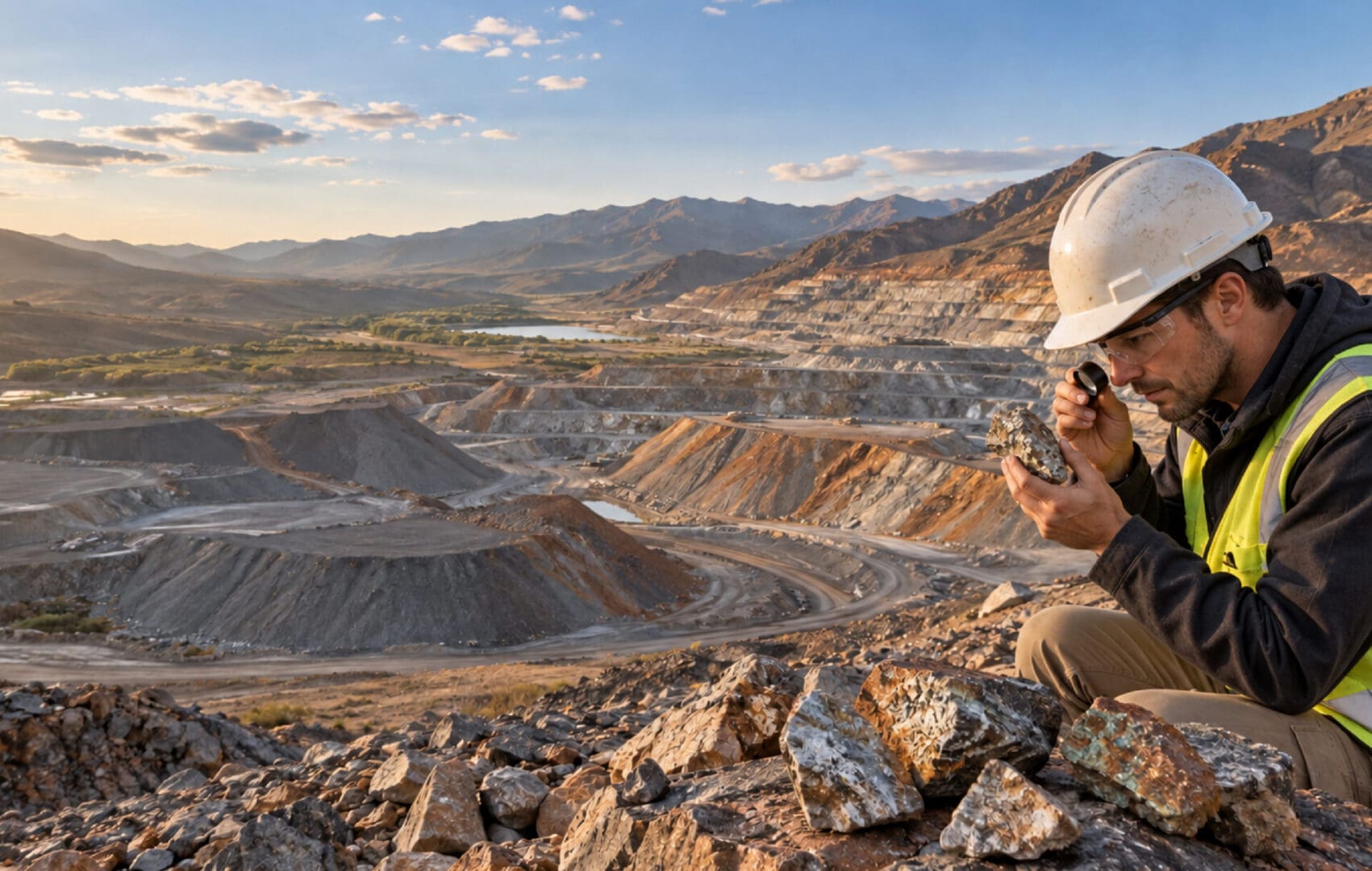
Mine Waste Is Still Rock. So Why Do We Stop Treating It That Way?
The mining industry is remarkably good at understanding rocks when we think there is something valuable inside them. We map lithologies, characterize alteration, study mineral assemblages, analyze geochemistry, and build increasingly sophisticated geological models. We recognize that mineral textures, chemical variability, and geological context can fundamentally change how material behaves. Yet when the same material falls below an economic cutoff grade, much of that complexity can disappear from the conversation.
A complex orebody can become a handful of waste classifications, supported by environmental tests and a plan for placement. Those classifications serve important purposes, but they do not erase the geology. The minerals are still there, and so are the reactions they may undergo when exposed to water, oxygen, or different processing conditions. Why would we stop asking geological questions simply because the material is now called waste?
Mine Waste Is Not Just a Closure Problem
Mining generates enormous volumes of waste rock, tailings, and process residues, with management obligations that can continue long after production ends. Some historical sites were developed under very different environmental expectations and now require expensive, long-term attention. At active operations, decisions about segregation, placement, water management, and final landforms can determine the difficulty of eventual closure. These are not simply questions of where to put unwanted material; they are questions about how geological materials will behave over decades.
The industry has strengthened tailings governance and environmental management, including through the Global Industry Standard on Tailings Management. Nevertheless, managing material safely and understanding it comprehensively are not necessarily the same thing. Better geological information cannot eliminate the need for engineering controls, monitoring, or closure planning. It can, however, help those decisions become more informed and better suited to the material being managed.
When Does a Rock Stop Being Geologically Interesting?
Two samples with similar bulk sulfur contents can have very different environmental behavior. Sulfur hosted in reactive sulfides is not equivalent to sulfur hosted in sulfate minerals, and the presence of neutralizing phases matters as well. Mineral grain size, liberation, textures, and associations influence reaction rates and the accessibility of reactive surfaces. A single assay result rarely captures all of those relationships.
This is where integrating geochemistry, mineralogy, and geological models can become particularly valuable. Geological domains can be evaluated for characteristics relevant to acid generation, metal leaching, dust, and material suitability for construction or cover systems. The goal is not to replace established acid-base accounting or kinetic tests with an attractive geological model. It is to use geological understanding to choose representative samples, interpret test results, and recognize variability that broad waste categories might conceal.
Are We Asking Waste Characterization Tests to Do Too Much?
A humidity cell or column test provides useful evidence about how a selected material behaves under controlled conditions. A waste rock dump, however, contains different particle sizes, variable mineral assemblages, preferential pathways for water and air, and zones that experience different temperatures and moisture conditions. Mixing, layering, and construction history can further change the reactions taking place. The challenge is deciding whether the material selected for testing adequately represents the system that will ultimately be built.
Imagine a geological unit containing both carbonate-rich and sulfide-rich intervals that are blended into a single composite. A bulk test may obscure important endmembers, particularly if the material will not remain uniformly mixed in the field. Geological domaining can help identify which endmembers deserve separate testing and which mixtures reflect realistic operational scenarios. Better sampling design will not remove uncertainty, but it can make the uncertainty more visible and more useful.
Why Wait Until the Waste Has Been Placed?
Many environmental decisions can be informed before the first truck reaches a waste dump. Drill core, multi-element geochemistry, mineralogical data, alteration models, and geological interpretations already exist at many operations. These datasets can be examined for patterns relevant to environmental performance, then tested against dedicated environmental measurements. The resulting geoenvironmental domains may inform mine planning, selective handling, segregation, and placement strategies.
For example, an operation may want to distinguish potentially acid-generating material from rock with greater neutralization capacity, while also accounting for metal mobility and the availability of suitable construction material. Other domains may require attention because of dust-forming minerals or because weathering could compromise long-term landform performance. None of these decisions should be made from geochemical proxies alone, and site-specific testing remains essential. The opportunity is to connect environmental characterization with the geological knowledge that the operation has already paid to collect.
This is also an important part of environmental geometallurgy: considering environmental performance alongside processing behavior and resource value. A material classification that is useful for metallurgy may not capture the variables that govern contaminant release. Conversely, an environmental domain may identify materials that could be managed or processed differently before they become a closure liability. Integrating those perspectives early can create options that disappear once materials have been mixed or placed.
What Happens When We Revisit Old Tailings?
Historical tailings are especially interesting because the original processing decisions were made under different commodity prices, recovery technologies, and environmental requirements. A deposit that was uneconomic to retreat twenty or fifty years ago may warrant a new assessment today. That assessment must consider grade, mineral deportment, tonnage, recoverability, contaminants, water management, permitting, and the costs of handling the remaining residues. The presence of metal alone is not a business case.
ReOre Technologies is developing the Medet Tailings project in Bulgaria, targeting copper and other critical materials from historical copper-molybdenum tailings. The company describes approximately 110 million tonnes of tailings at the site and a strategy that combines resource recovery with remediation and restoration. This is a development-stage example, not proof that every large tailings inventory can be profitably reprocessed. It does show how a historical waste deposit can be evaluated as both a potential resource and an environmental responsibility.
Regeneration approaches the problem from a slightly different direction, seeking to recover minerals from legacy mine waste while supporting site restoration. At Hedley in British Columbia, the company has described drilling, groundwater monitoring, characterization, and feasibility work to evaluate metals recovery alongside remediation of historical tailings. This is particularly compelling because the technical question is not limited to how much metal remains. It also asks whether recovery can help finance a better long-term outcome for the site and surrounding community.
Waste Can Become a Feedstock Without Reopening a Mine
Some of the most interesting opportunities occur outside conventional tailings reprocessing. Rio Tinto has produced scandium oxide at Sorel-Tracy in Quebec from waste streams generated during titanium dioxide production. Its process was designed to recover a critical mineral without additional mining, illustrating how a residue from one industrial process can become the feedstock for another. That does not make every process residue commercially attractive, but it changes the questions worth asking about existing streams.
New technology companies are also working on the separation and refining steps needed to make unconventional feedstocks useful. Phoenix Tailings has developed rare earth processing and metallization capabilities, including technologies initially associated with recovering value from mining waste. Its expanding refining business should not be confused with proof that all of its feedstock comes from tailings. The larger lesson is that recovery technology, mineralogy, and access to processing infrastructure can all determine whether a material becomes a resource.
Closure, Recovery, and Environmental Risk Have to Be Evaluated Together
Reprocessing an old tailings deposit is not automatically an environmental improvement. Excavation can disturb previously stable material, create dust, change water chemistry, or produce a new residue requiring secure storage. A project that recovers valuable metals but leaves behind a more reactive or more difficult-to-manage waste stream may simply move the liability. Environmental baseline studies, geochemical characterization, process testing, and credible closure plans need to be part of the economic evaluation from the beginning.
In some cases, the best outcome may be retreatment followed by improved containment and restoration. In others, stabilization, capping, water treatment, or leaving material undisturbed may be more appropriate. The right answer depends on site conditions, risk, technology, community priorities, and the full life-cycle economics. Better geochemistry helps distinguish these possibilities rather than assuming that recovery is always preferable.
Why Is Environmental Geochemistry So Difficult to Fund?
Every year, in boardrooms and project planning meetings, budgets force difficult decisions about where money should be spent. Environmental geochemistry and geoscience can be a particularly difficult investment to explain because their benefits often emerge years after the original work is completed. The questions are familiar: Could we run two fewer humidity cells, reduce the kinetic testing program, or postpone additional characterization until later? These are reasonable budget questions, but they can overlook the much larger cost of making decisions with an incomplete understanding of the material.
The answer is not necessarily to request more tests or a larger environmental budget. It is to rethink how environmental geochemistry is proposed, designed, and integrated with the geological and operational decisions already being made. Could existing drill core, mineralogy, geochemical datasets, and geological models help identify which samples genuinely require kinetic testing? Could a more deliberate approach to geological domaining reduce redundant testing while making sure that the highest-risk materials are not overlooked?
Environmental geochemistry should not be presented only as a regulatory requirement or a future closure expense. It can inform waste segregation, material handling, water management, processing options, construction materials, and long-term liability while those decisions are still flexible. That requires environmental specialists, geologists, metallurgists, mine planners, and decision-makers to work together earlier rather than treating characterization as a separate exercise. We have only one Earth, and understanding the materials we move and leave behind should be part of how mining projects create value, not simply a cost to minimize.
The Opportunity Starts With Better Questions
The mining industry does not need to pretend that all mine waste is a hidden orebody. Much of it will remain waste, and managing it safely will continue to be a major responsibility. Yet geological thinking should not end when a material is assigned a waste classification. Its mineralogy, chemistry, textures, and geological history still influence what happens next.
Could more careful geological domaining improve environmental testing and closure predictions? Could material be segregated earlier to reduce future liabilities or preserve options for recovery? Could historical tailings or process residues be revisited with modern analytical methods and more realistic economic assumptions? Those are questions worth asking, because the value of understanding a rock does not end when we decide not to mine it.
For more rethinking mine waste, listen to Anita Parbhakar-Fox discuss her vision for the future of mine waste on the GeOCHemISTea Podcast.
